Recently, the “Cannabis Small Business Association” posted a reel making some bold claims about Virginia’s upcoming recreational cannabis legislation. Let’s go line by line, what did they say, what did they leave out, and why might they have framed it this way?
“Virginia is about to hand over the cannabis industry to corporate giants, and most people have no idea what’s happening.”
Let’s call this what it is: fearmongering. The opening line is designed to alarm rather than inform, and it sets the tone for everything that follows.
“Hemp and marijuana are both considered cannabis. The big distinction is THC content.”
Fair enough. This part is accurate, and we’ll give credit where it’s due. But…..

“What the new REC bill does is redefine the majority of legal hemp products to now be marijuana.”
This framing is misleading. Hemp, by definition, should not contain meaningful levels of THC. Products being “redefined” as marijuana are those that already contain significant THC, the very distinction the CSBA just acknowledged. If your hemp product has THC levels that qualify it as marijuana, that’s a product formulation issue, not a regulatory overreach.
“And the state wants to go from over 2,000 hemp licenses to 350 marijuana licenses.”
This is a deliberate omission. The full picture: Virginia will maintain up to 2,000 hemp licenses and add 350 retail cannabis storefronts, alongside theoretically unlimited licenses for micro-businesses, cultivation, processing, distribution, and delivery operations. The hemp industry isn’t being replaced, it’s being given an on-ramp to convert if operators choose to do so.
“To offer additional context, there’s over 30,000 alcohol licenses in Virginia.”
This is number-shifting, plain and simple. Alcohol licenses in Virginia are not a monolithic category. You have state-run ABC stores selling liquor (roughly 398 locations), private retailers licensed to sell beer and wine (approximately 18,000), bars and nightclubs (around 392 registered businesses), and then a significant portion of Virginia’s 23,000+ restaurants and cafes that also hold alcohol licenses. These are completely different license types serving different purposes.
What’s worth noting is that Virginia is actually taking a measured, liquor-store-style approach to rolling out recreational cannabis, 350 cannabis retail storefronts compared to roughly 398 ABC liquor stores. That’s not a dramatic disparity; it’s a deliberate, phased rollout. The CSBA’s alcohol comparison obscures this rather than clarifying it.
“And in order for a hemp operation to continue, they would need to buy an expensive lottery ticket and compete in a pool of thousands of applicants, some of which have never even operated in the cannabis industry.”
Here’s an interesting slip. The CSBA seems to view first-time applicants as a problem, but wouldn’t a first-time applicant more likely be a Virginia-native small business entrepreneur entering the market for the first time? That’s exactly who these licensing structures are meant to support. The concern here appears less about protecting small businesses and more about protecting incumbent hemp multi-state operators (MSOs) from having to compete on equal footing.
“This bill would eliminate the majority of small businesses currently operating in Virginia’s hemp market and hand the industry over to a very small number of large operators.”
This claim doesn’t hold up under scrutiny. Which small businesses, exactly? The CBD and hemp shops recently facing charges in Caroline County?(personal note: no one should be charged unless the FBI starts charging the the owners of the medical cannabis stores that are operating nation wide) And which hemp products are actually at risk here, specifically, the high-THC products like shipped-in(from non local, non small businesses) THCa flower that are pushing the legal definition of hemp to its limits?
The CSBA conspicuously avoids the central question: how much THC (whether THCa, delta-8, delta-9, or various synthetics) is present in the hemp products they’re defending? That omission is telling.
The Bottom Line
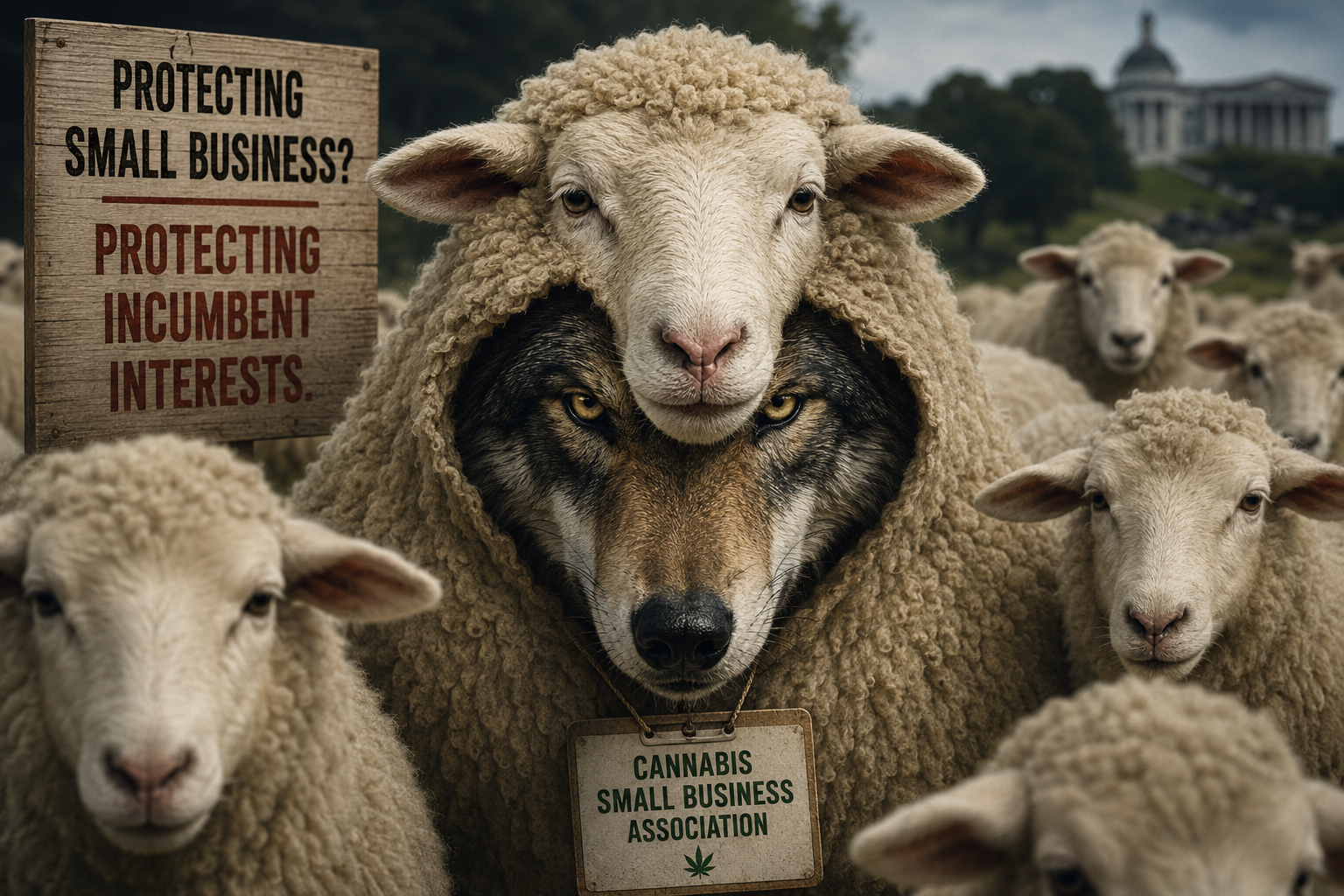
The Cannabis Small Business Association is behaving like a wolf in sheep’s clothing, invoking the language of small business advocacy while appearing to protect the interests of larger incumbent operators who want to maintain their foothold in a loosely regulated gray market.
Virginia’s local cannabis community has deep roots that don’t forget. If the CSBA wants to be a credible voice in this space, they need to be honest about who they’re actually representing, and what’s actually in the products they’re defending.