
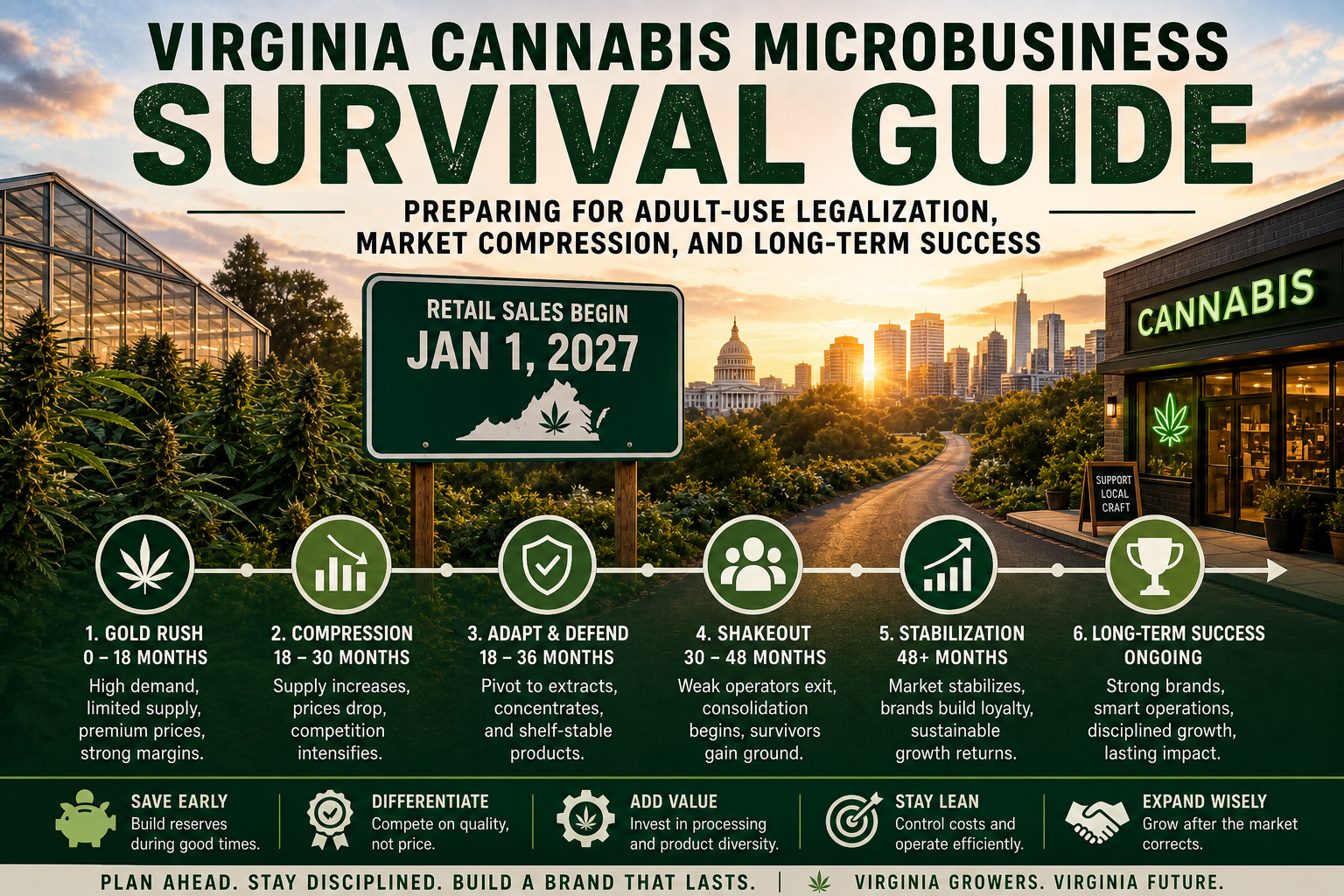
Preparing for Adult-Use Legalization, Market Compression, and Long-Term Success
Editorial Update (May 2026): This guide has been updated to reflect the rejection of earlier legislative amendments that would have accelerated retail launch. The current projected start date for regulated adult-use sales is now January 1, 2027. All timelines below reflect this revised date.
Virginia is now positioned to launch regulated adult-use cannabis sales on January 1, 2027. For Virginia microbusinesses, this represents both a major opportunity and a serious warning.
History from nearly every recreational cannabis state shows the same pattern:
- Initial scarcity and inflated pricing
- Rapid expansion and oversupply
- Heavy price compression
- Corporate consolidation
- Craft market separation and stabilization
The businesses that survive are rarely the ones that simply grow the most product. They are the ones that understand the timeline, prepare financially, and adapt before the market turns.
This guide outlines what Virginia operators should expect and how microbusinesses can strategically navigate the lifecycle of a newly legal cannabis market.
Phase 1: The Gold Rush Period
Estimated Timeline: Launch Through 12–18 Months After Retail Opens
When adult-use markets first launch, supply is usually limited while consumer demand is extremely high.
This creates:
- Elevated wholesale pricing
- Elevated retail pricing
- Strong margins
- Rapid consumer adoption
Colorado, Michigan, New York, and other adult-use states all experienced this “honeymoon” period before competition increased and prices declined.
Virginia Projection
With retail launching January 1, 2027:
| Window | Period |
| Gold Rush Window (Projected) | January 2027 – Mid-2028 |
Recommended Strategy During the Gold Rush
Do NOT Overspend Early
Many growers make the mistake of seeing early profits and assuming those margins are permanent. They are not.
The most common failure pattern in legal cannabis:
Businesses over-expand during Year 1, then collapse during Year 2 when prices crash.
Instead, microbusinesses should:
- Operate lean
- Avoid unnecessary debt
- Build reserve capital
- Delay major expansion until the market stabilizes
Financial Rule of Thumb
During the first 12–18 months, treat profits like temporary windfall income, not permanent revenue.
A healthy operator should aim to:
- Save 30–50% of all profits
- Build operating reserves
- Maintain 6–12 months of runway
- Assume pricing will decline dramatically
Phase 2: The Compression Period
Estimated Timeline: 18–30 Months After Launch (Mid-2028 Through Mid-2029)
Once more licenses come online and production ramps up:
- Supply catches demand
- Wholesale prices begin falling
- Retailers run promotions
- Large operators deploy loss leaders
- Market competition intensifies
Michigan is a prime example, where flower pricing dropped dramatically after expansion. Retail averages fell sharply over several years.
This phase is where weak operators exit the market.
Understanding Loss Leaders
Loss leaders occur when large companies sell product at cost, near cost, or below cost in order to:
- Capture market share
- Starve competitors
- Increase foot traffic
- Push inventory quickly
Large MSOs can absorb this because they have multiple revenue streams, investor backing, and can sustain temporary losses. Microbusinesses usually cannot.
How Small Growers Should Respond
Never try to win a price war.
If a corporate grow sells ounces for $80, do not try to sell yours for $75. You will lose. They can sustain losses longer than you can.
Instead: Differentiate.
Craft Positioning Strategy
Microbusinesses must become premium, specialized, unique, and brand-driven. Examples:
- Exotic / boutique genetics
- Living soil / certified organic branding
- Solventless hash / rosin focus
- Small-batch limited drops
- Terpene-rich premium flower
- Hyper-local branding and regional identity
- Legacy grower storytelling
Phase 3: Adaptation and Defensive Operations
Estimated Timeline: 18–36 Months After Launch (Mid-2028 Through Early 2030)
When flower pricing falls, microbusinesses should pivot excess flower into value-added products:
- Rosin
- Hash and solventless concentrates
- Pre-rolls
- Edibles
- Shelf-stable infused products
Why? Because processed goods:
- Preserve value longer
- Extend shelf life
- Reduce waste
- Increase margin potential
- Prevent forced discounting of flower
Should Growers Shut Down During Compression?
Generally, no. Instead of fully shutting down, reduce production and operate leaner:
- Fewer rooms active
- Smaller crop cycles
- Higher quality standards
- Lower labor overhead
Maintain market presence, shelf space, consumer loyalty, and brand visibility. If you disappear completely, customers move on, shelf space is lost, and competitors fill your place.
When Should Microbusinesses Expand?
Not during Year 1.
Expansion should happen after market correction begins. By then:
- Equipment prices may have fallen
- Competitors may have failed or exited
- Real estate opportunities open up
- Labor availability improves
- You have real data on true market demand
Smart Expansion Window — Projected Virginia Timeline
| Year | Market Phase | Suggested Action |
| 2027 | Launch (Jan 1) | Operate lean, maximize early margins |
| 2028 | Peak Premium Window | Save aggressively, avoid overexpansion |
| 2029 | Compression Begins | Pivot products, reduce waste, lower overhead |
| 2030 | Market Shakeout | Consider strategic expansion or acquisitions |
| 2031+ | Stabilized Market | Scale intelligently from a position of strength |
Suggested Grow Timeline for Virginia Launch
Assuming January 1, 2027 retail start date:
First Crop Planning
| Stage | Estimated Timing |
| Licensing / Regulatory Prep | Summer–Fall 2026 |
| Facility Buildout | Fall 2026 |
| Genetics Selection / Mother Plants | October–November 2026 |
| First Production Run | November–December 2026 |
| Harvest / Cure | December 2026 |
| Launch Inventory Ready | January 1, 2027 |
Important Note: With a January 1st start date, operators have less runway than a mid-year launch. Licensing and buildout must begin no later than summer 2026 to hit inventory targets. Operators who have not started this process should treat it as urgent.
Long-Term Winning Strategy for Virginia Microbusinesses
- Survive First, Profit Second. Build for sustainability, not hype.
- Save During Good Times. Treat early profits as temporary.
- Build Brand Immediately. Consumers remember brands, not growers.
- Develop Processing Capability Early. Prepare secondary revenue channels before you need them.
- Never Race to Bottom Pricing. Compete on value, quality, and identity.
- Expand Only After Correction. Buy equipment and real estate while others are panicking.
Final Thoughts
Virginia microbusinesses have a rare opportunity: they can study every other state’s mistakes before launch. The pattern is entirely predictable.
The first wave gets rich. The second wave gets squeezed. The prepared survive. The strategic thrive.
With Virginia’s adult-use market now targeting a January 1, 2027 launch, the premium window will likely last 12–18 months before increased competition and price pressure emerge — consistent with patterns seen in comparable states.
The operators who win will not necessarily be the biggest growers. They will be the growers who:
- Begin licensing and buildout now
- Prepare for compression before it arrives
- Preserve capital during the gold rush
- Build defensible, recognizable brands
- Pivot before panic sets in
The clock started when the amendments were rejected. January 2027 is not far away.