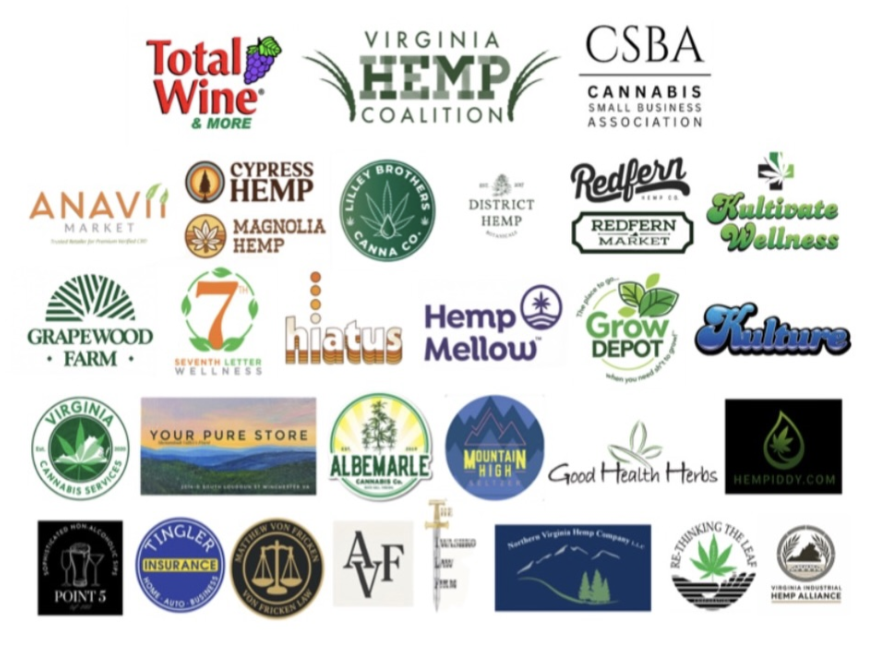
Virginia’s cannabis debate has taken an unexpected turn. A coalition presenting itself as defenders of “small business” recently sent a letter urging Governor Abigail Spanberger to veto the Commonwealth’s adult-use cannabis legislation. The letter framed itself as a plea for fairness, consumer safety, and protection for local hemp operators.
But buried within that coalition is a name that changes the entire conversation: Total Wine & More.
That raises a serious question:
If the cannabis industry partnering with large multistate operators (MSOs) is considered dangerous corporate influence, why is a partnership with one of the largest alcohol retailers in America suddenly acceptable?
The “Corporate Cannabis” Argument Falls Apart
For months, critics of Virginia’s adult-use cannabis legislation have warned that legalization would “hand the market to corporations.” The message is emotionally effective because many Virginians genuinely want small farmers and independent businesses to succeed.
But that argument becomes difficult to take seriously when one of the most powerful alcohol retailers in the country appears aligned with the effort to delay or weaken the regulated cannabis rollout.
Consider the scale involved:
Total Wine & More is the largest independent alcohol retailer in the U.S., generating an estimated $6 billion in annual revenue and employing over 11,000 people. The massive chain operates nearly 300 superstores across 30 states and the District of Columbia, alongside a highly trafficked e-commerce platform.
This is not a struggling local startup trying to survive regulatory uncertainty.
This is a national retail giant with enormous financial leverage and political influence.
A New Alliance: Alcohol + Hemp
The emerging relationship between segments of the hemp industry and large alcohol interests appears less about protecting “small business” and more about preserving access to intoxicating THC products outside the fully regulated cannabis system.
That distinction matters.
Virginia’s proposed adult-use cannabis framework would create:
licensed cannabis retailers,
seed-to-sale tracking,
stricter compliance systems,
testing standards,
tax structures,
and dedicated cannabis oversight.
Meanwhile, many intoxicating hemp-derived THC products currently operate through a far looser framework.
For major retailers, that model has advantages:
lower barriers to entry,
broader retail distribution,
fewer cannabis-specific restrictions,
and the ability to sell intoxicating products without participating in the regulated cannabis market itself.
That is not a small-business revolution.
That is market positioning.
Partnering With Total Wine Is No Different Than Partnering With MSOs
Some activists and organizations have spent years warning Virginians about the influence of MSOs, multistate cannabis operators with deep pockets and large-scale infrastructure.
But partnering with a national alcohol retail giant while criticizing cannabis corporations creates a glaring contradiction.
Functionally, the argument becomes:
corporate cannabis influence is bad,
but corporate alcohol influence is acceptable if it protects hemp-derived THC sales.
That is not an anti-corporate position.
It is selective corporate alignment.
If the concern is truly about protecting Virginia entrepreneurs, then the solution should be:
creating pathways for small cannabis operators,
launching a regulated market,
improving licensing access,
and refining regulations over time.
Not indefinitely delaying legalization while existing intoxicating product markets continue operating under separate rules.
Delaying the Market Helps Large Players Most
One of the most overlooked realities in cannabis policy is this:
Large corporations survive uncertainty better than small businesses do.
When legalization is delayed:
investors pull back,
startups stall,
small growers lose momentum,
ancillary businesses struggle to plan,
and aspiring entrepreneurs remain frozen out.
Meanwhile, major corporations, whether alcohol, hemp, or cannabis, can wait indefinitely.
They already have:
capital,
infrastructure,
distribution systems,
legal teams,
and lobbying resources.
The people hurt most by continued delay are the very small operators being used rhetorically in these debates.
The Real Fight Is About Market Control
At its core, this is becoming a fight over who gets to dominate intoxicating THC commerce in Virginia.
Will it be:
a regulated cannabis market with dedicated licensing and oversight,
or
a hybrid system where major retail interests continue selling intoxicating products through hemp loopholes and alternative regulatory channels?
That is the real policy debate beneath the slogans.
Because once national retail chains and powerful industry coalitions begin aligning against a regulated cannabis rollout, it becomes increasingly difficult to argue this is simply a grassroots movement to protect local farmers.
Virginia Should Build Forward, Not Stay Frozen
No legislation is perfect.
Virginia’s cannabis framework will evolve over time just like every other regulated industry.
But delaying the market again does not create opportunity.
It prolongs uncertainty.
If improvements are needed:
refine the licensing process,
expand microbusiness support,
strengthen transition pathways,
and improve enforcement consistency.
But Virginia should not allow fear campaigns, selective corporate alliances, or loophole economics to indefinitely postpone the launch of a legitimate regulated cannabis industry.
Because at some point, “protecting small business” stops being the mission and starts becoming the branding strategy for preserving market share.